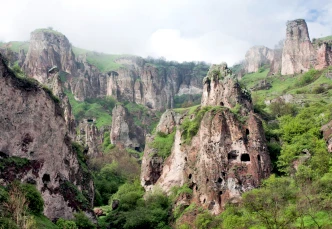
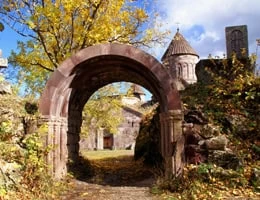
Just eight kilometers from Goris lies Khndzoresk – a village where nature itself seems to have played the role of architect. Instead of ordinary houses, cave dwellings carved into towering cliffs form a stone labyrinth, while winding paths stretch across hills that have never known a flat line.
Old Khndzoresk, woven from mist and stone, sheltered generations who lived in harmony with a land both harsh and generous. This historic cave settlement is known for its natural and man-made caves, four churches and three schools, and was once home to up to 15000 people. To reach different parts of the village, residents used a complex system of ropes and ladders.
During the Syunik liberation movement of 1722-1730, Khndzoresk became one of its strongholds. Its gorges and crags served as natural fortress walls, sheltering warriors who rose to defend their homeland. Here rests the legendary commander Mkhitar Sparapet, defender of Armenia, alongside his faithful wife Gohar and their son Aaron. Their names still echo through the caves as symbols of devotion and courage.
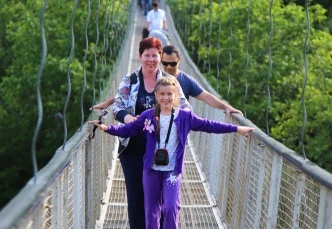
Today, a new landmark leads to the ancient village – a swinging bridge stretched above the abyss like a road linking past and present. Measuring 160 meters in length and 1.5 meters in width, and rising 63 meters above the gorge, this 14-ton crossing can hold up to 700 people at once. From it unfolds a breathtaking panorama of Old Khndzoresk, where stone and history merge into one eternal monument. From there, visitors can see the churches of Khndzoresk and the "Nine Children" spring.