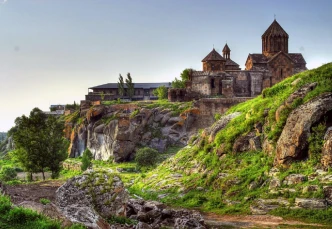
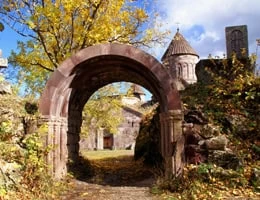
Not far from the town of Talin, the mighty fortress of Dashtadem rises above the village of the same name, like a stone guardian of the centuries. This castle is one of the greatest monuments of medieval Armenia, originally built to shield the fertile Ararat Valley from enemy invasions. Its foundations stretch back to the Urartian era, while the first citadel was erected by the powerful Kamsarakan dynasty, whose ambitious constructions left a deep imprint on the region.
Dashtadem's history is marked by shifting rulers and eras. After the fall of the Bagratunis, Armenia passed under Seljuk rule and in the late 12th century the last ruler of Ani – Sultan ibn Mahmud – added polygonal and semicircular bastions, leaving on one an inscription in Arabic. Soon the Zakaryan princes reinforced the fortress with new walls and semicircular towers and raised a monumental church near its northern ramparts, underscoring the site's spiritual meaning.
A new chapter began in the 19th century, when Hussein Khan, the ruler of Yerevan, built massive basalt walls with eight corner towers. It was then that Dashtadem became the largest fortress in Armenia – a symbol of resilience and grandeur.
Today, Dashtadem stands as a living testimony to centuries of struggle, heritage and architectural mastery. Its walls, bearing the marks of Urartian, Armenian, Arab and Persian hands, tell the story of a land that defended its soil and its faith through the ages.